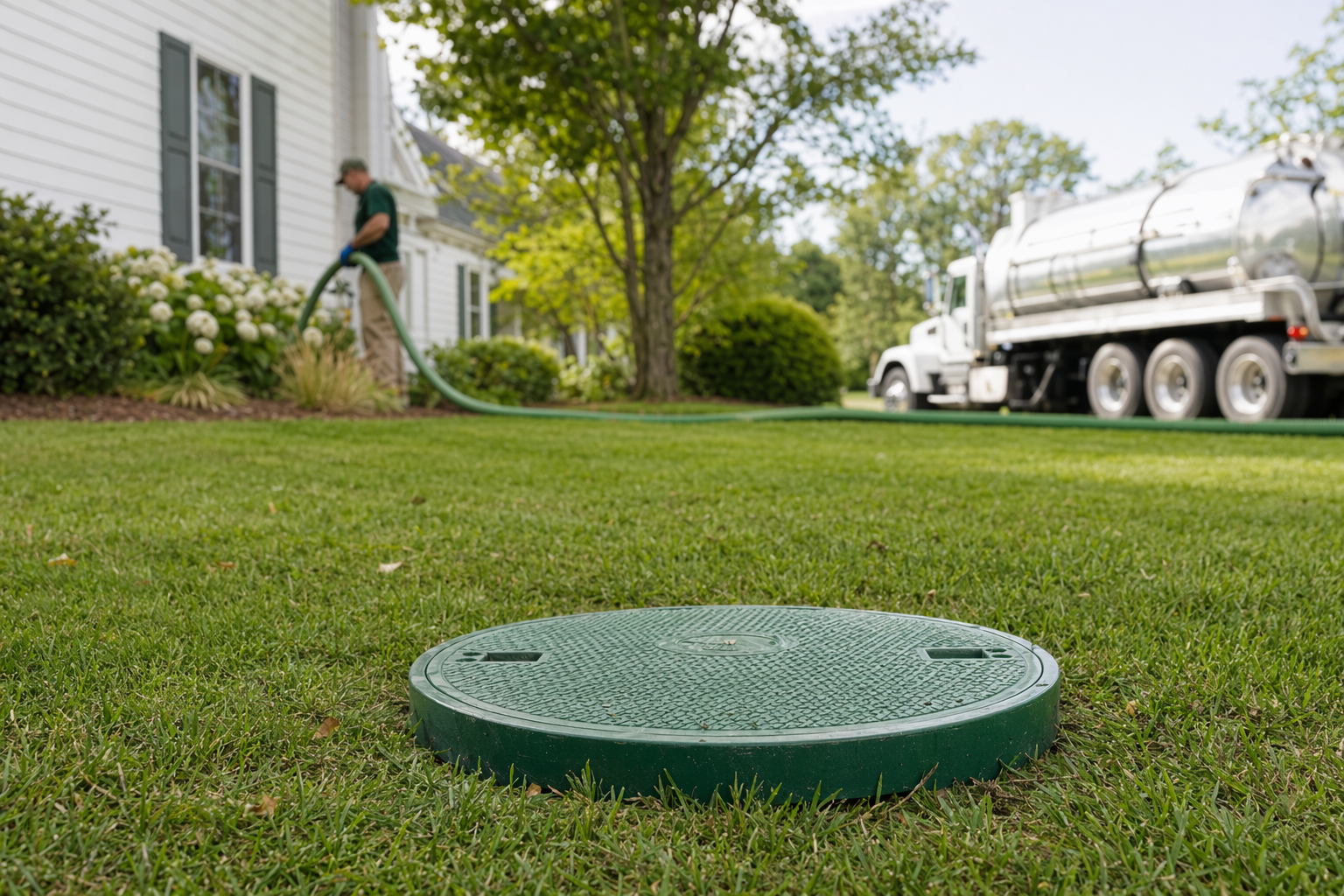
How to Find My Septic Tank and Lid
Your septic tank is usually buried in the yard between your house and the drain field. In many homes, it sits 5 to 25 feet from the foundation, often in a straight line from the main sewer pipe that exits the house.
The lid is the access point on top of the tank. Some tanks have one lid, some have two. Older lids may be buried several inches or even deeper below the surface. Newer systems may have risers, which are vertical access pipes that bring the lid closer to ground level.
If you are seeing slow drains, odors, gurgling, or a backup, do not keep digging if you are not sure what you are uncovering. Raw sewage is a health risk. Keep children and pets away from wet or smelly areas, and if sewage is backing up into the home, see quick septic answers or emergency septic service.

The short answer
Start with the easiest clues first:
- Check property records, septic permits, inspection reports, or an old drawing of the system.
- Find where the main sewer pipe leaves the house, usually in the basement, crawl space, or where plumbing exits the slab.
- Follow that line outside. The tank is often straight out from that pipe.
- Look for signs in the yard, a slight mound, a shallow dip, greener grass, a plastic or concrete cover, or two lids spaced several feet apart.
- Probe carefully only in the suspected tank area, not across the whole yard.
- If you still cannot find it, call a licensed septic company or inspector.
If you want a quick refresher on the parts, how a septic system works explains the tank, outlet, and drain field in plain English.
What you need to know
A few things make septic tanks harder to find than people expect.
- Tanks are almost always buried.
- Grass can hide the location completely.
- Older homes may have missing or incomplete records.
- Landscaping, patios, sheds, or additions may have changed the yard after the system was installed.
- Not every lid is visible from the surface.
The tank is not usually right next to the house, and it is not the same thing as the drain field. The drain field is the area where wastewater goes after leaving the tank. You should not dig randomly in the drain field or drive equipment over it.
Tank lids can be heavy concrete, fiberglass, or plastic. Some older lids and access covers can be unsafe if damaged. Never step on a questionable lid. Never enter a septic tank. Septic gases can be deadly, and confined space entry is not a homeowner DIY job.
Also, finding the tank is different from judging its condition. A visible lid does not tell you whether the system is healthy, full, damaged, or failing. If you are trying to solve a problem, you may need septic tank pumping or septic inspection, depending on the situation.
Steps to take
Use this simple process.
1. Start with paperwork
- Look for the as-built drawing, permit, plot plan, closing papers, or past pumping receipts.
- Check with your county or local health department to see whether septic records are on file.
- If you bought the home recently, ask the seller or agent if they have a tank diagram or service history.
2. Locate the main sewer pipe inside the home
- In a basement or crawl space, look for the largest drain pipe leaving the house.
- In slab homes, look for the direction the plumbing exits the wall or floor toward the yard.
- This pipe usually points toward the tank.
3. Go outside and estimate the path
- Measure straight out from that exit point.
- Many tanks are found within 5 to 25 feet, but some are farther away.
- Look for a clear route with no sharp turns. Septic lines are usually laid out as directly as practical.
4. Look for surface clues
- A small rise or shallow depression.
- Greener grass over one rectangular area.
- An exposed cap, pipe, or cleanout.
- Two access points a few feet apart.
- In winter, a patch that melts faster than nearby ground.
5. Probe gently, only after narrowing the area
- Use a thin probe rod carefully in soft soil.
- Stop if you hit something solid and broad that may be the tank top.
- Do not use force near plastic components or shallow pipes.
- Do not dig with heavy equipment unless you know where the tank and lines are.
6. Expose the lid carefully
- Dig by hand once you are confident you found the tank top.
- Clear enough area to identify the access lid without prying at random.
- If the cover looks cracked, unstable, or unusually heavy, stop and call a pro.
7. Consider adding risers after service
- Risers bring access lids closer to the surface.
- This can make future pumping and inspections easier.
- If you are interested, ask the septic pro what is appropriate for your system.
If you are not finding the tank, or if you need service soon, get matched with a trusted septic pro. Leachstead is a free matching service. You compare options and confirm price before work starts.
Common mistakes
These are the most common ways homeowners lose time, or create a safety problem.
- Digging all over the yard without first checking records.
- Confusing the septic tank with the drain field.
- Assuming the tank must be right beside the house.
- Probing aggressively and damaging a pipe or lid.
- Opening a lid without the right tools and help.
- Standing on an old or cracked cover.
- Letting kids or pets near wet soil, sewage, or an open tank.
- Driving over the suspected tank or drain field with a truck, tractor, or excavator.
Another common mistake is calling the first company and approving work without asking questions. Septic work often requires permits and licensed or certified installers, especially for repairs, replacement, lid work, or changes to access. Verify the license, the permit, and your local rules yourself. Get written quotes when possible, and confirm the price before work starts.
If your goal is routine care after you find the tank, our septic services page can help you understand the types of help homeowners usually request.
Get matched with a pro
If the tank is hard to locate, the lid is buried deep, or you are dealing with slow drains, odors, or sewage backup, it may be faster and safer to bring in a professional.
A local septic pro may use records, site knowledge, line tracing, or careful probing to locate the tank and access lid. If needed, they may also recommend pumping or inspection based on what they see. Typical ranges for septic work vary by area and job, so treat any price you hear as a starting point, not a quote.
Leachstead is not a septic company. We do not pump, inspect, repair, or approve systems. We are a free information and matching service for homeowners in the US, including people who prefer help in another language. Tell us what is going on, and you can get matched with a trusted local septic pro to compare and choose.
Common questions
How far is a septic tank usually from the house?
A common range is about 5 to 25 feet from the house, often in line with the main sewer pipe. But every property is different. Some tanks are farther away because of lot layout, slopes, setbacks, or older installation choices.
Can I use a metal detector to find my septic tank lid?
Sometimes, but not always. It may help if the lid or hardware contains metal. Many lids and risers are concrete, plastic, or fiberglass, so a metal detector can miss them. Records and tracing the sewer line are usually more reliable starting points.
Should I dig up my septic lid myself before pumping?
You can sometimes uncover a known lid carefully by hand, but stop if you are unsure of the exact location or if the cover looks damaged or very heavy. Never enter a septic tank, never stand on a questionable lid, and keep children and pets away. If there is any sewage backup or a suspected failure, call a licensed septic pro.