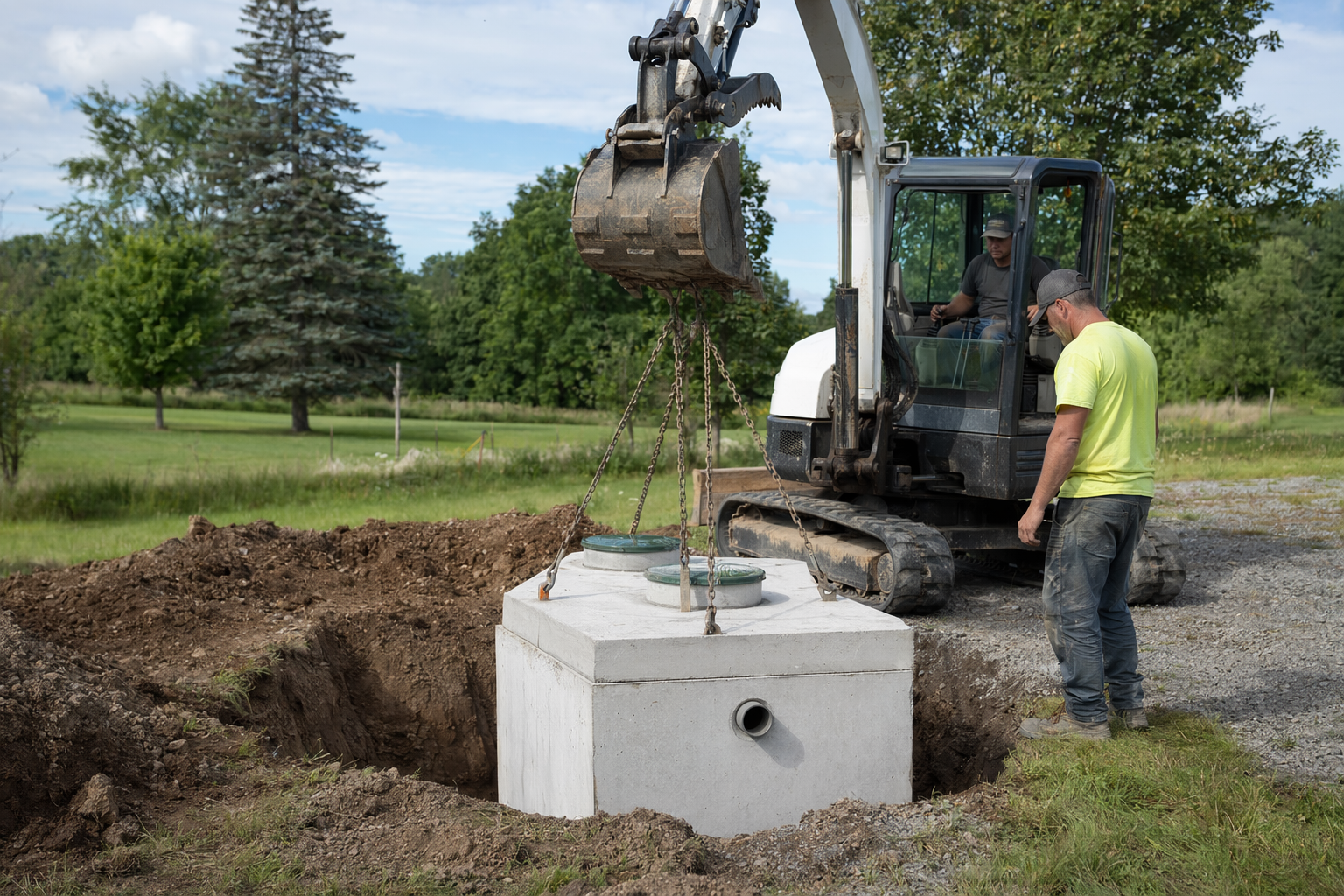
Septic failure and replacement, what “failure” really means
A septic system is considered to have failed when it is no longer treating and moving wastewater safely. In plain English, that means sewage is backing up, surfacing in the yard, or not soaking into the soil the way it should.
A true failure is more than an inconvenience. It can affect your home, your yard, nearby water, and your family’s health. That is why this is not a DIY project when sewage is involved.
Failure can happen in different ways:
- The tank is overdue for pumping and solids are too high.
- A pipe or baffle is damaged.
- Tree roots have gotten into the line.
- The drain field, also called the leach field, is clogged, flooded, crushed, or worn out.
- The system was undersized, installed badly, or is simply at the end of its life.
Repair may be possible if the problem is limited and the rest of the system is still sound. Replacement is more likely if the drain field is failing, the system is very old, the soil no longer accepts wastewater, or the current layout does not meet today’s local rules.
If you want a refresher on the parts involved, see How a septic system works.

Why it matters
A failing septic system is not just a plumbing annoyance. Raw sewage and untreated wastewater are health and groundwater hazards. Keep children and pets away from wet, smelly, or sewage-affected areas. Avoid direct contact. If sewage is backing up into the house, limit water use and consider urgent help through emergency septic service.
It also matters financially. Homeowners often hope a pump-out alone will solve everything. Sometimes it helps for a short time. But if the real problem is a damaged drain field or failed layout, pumping may only buy a little time.
Typical US cost ranges, not quotes:
- Pumping, about $250 to $700
- Basic inspection, about $250 to $600
- Common repairs such as baffles, lids, filters, or small line fixes, often about $150 to $1,500
- Sewer line or tank-area repairs, often about $1,000 to $5,000+
- Drain field repair, partial rebuild, or limited restoration, often about $2,000 to $10,000+
- Full septic replacement, often about $7,000 to $25,000+, and sometimes more for difficult sites or alternative systems
Why such a wide range? Soil, slope, groundwater, tank size, accessibility, permits, local labor rates, and the type of system all affect price. Mound, aerobic, pressure-dosed, or other alternative systems can cost much more than a standard gravity system.
For broader ranges, visit Septic costs explained.
How it works, how a pro decides repair vs replacement
A good septic pro does not guess from one symptom. They inspect the whole situation.
A typical process looks like this:
1. Ask about symptoms and history
They may ask when it was last pumped, whether backups happen after laundry or rain, how old the system is, and whether there have been past repairs.
2. Check the tank and levels
They may open access lids, measure sludge and scum, check the inlet and outlet baffles, and look for signs that wastewater is not leaving the tank properly.
3. Inspect lines and the drain field area
They may look for wet spots, sewage odor, unusually green grass, root intrusion, crushed pipes, or signs of ponding over the field.
4. Test flow and sometimes use a camera or probing tools
This helps separate a clogged building sewer, a full tank, and a failing drain field.
5. Review site and permit limits
If replacement may be needed, the next step is often design work, local approval, and sometimes soil or perc-related testing. Local health department rules matter here. You should verify permit needs, installer licensing, and local setbacks yourself. Leachstead is a free matching and information service, not the permitting authority.
In many cases, repair is more realistic when:
- The tank is structurally sound.
- The problem is a filter, baffle, pipe, lid, or root blockage.
- The drain field is not clearly failed.
- The issue is tied to deferred maintenance rather than a worn-out system.
Replacement is more realistic when:
- Sewage is surfacing over the drain field.
- The field stays saturated or flooded even after pumping and water-use reduction.
- The tank is cracked, collapsed, or badly deteriorated.
- The system is too small for the home’s current use.
- Multiple major parts are failing at once.
- A prior “repair” only worked briefly.
- The site or old layout no longer meets local requirements.
If the field is the big question, our page on drain field and leach field repair can help you understand what may be fixable and what may not.
What to watch for
Some warning signs point to a maintenance issue. Others suggest a system that may be failing.
Watch for:
- Slow drains in several fixtures
- Toilets that gurgle or bubble
- Sewage odor inside or outside
- Wet, soggy, or unusually green patches over the drain field
- Backups in the lowest drains, tubs, or showers
- Problems that get worse after rain
- A tank that needs pumping unusually often
A few important notes:
- One slow sink does not always mean septic trouble. It could be a local drain clog.
- Whole-house symptoms are more concerning than one fixture.
- A fresh pump-out does not prove the system is healthy. If symptoms come back soon, more evaluation is needed.
- Strong odor and surface wetness near the field are serious signs.
For a fuller list, see Septic warning signs.
While you wait for help:
- Use as little water as possible.
- Do not run extra laundry or long showers.
- Keep cars, heavy equipment, and digging away from the tank and drain field.
- Keep children and pets out of affected areas.
- Do not open tanks or enter any septic space yourself. Septic gases and confined spaces are dangerous.
Common mistakes
When people are stressed, they often spend money in the wrong order. These are the most common mistakes homeowners make:
- Assuming pumping will fix a failed drain field. Pumping can help a full tank. It cannot rebuild worn-out soil treatment.
- Waiting too long after repeated warning signs. Small repairs are sometimes possible early. Long delays can turn a limited issue into a larger one.
- Using additives as a rescue plan. Additives are not a proven cure for system failure.
- Driving or building over the drain field. This can crush pipes and compact soil.
- Getting only one opinion on a very expensive replacement. Sometimes replacement is necessary. Sometimes a careful second opinion finds a repairable issue.
- Not asking what is included in the price. Soil work, permits, restoration, inspection fees, pumping, and electrical work may or may not be included.
- Skipping paperwork. Septic work often requires permits, site review, and licensed or certified installers, depending on your area. Verify license status, permits, and local rules yourself before work starts.
A smart way to compare options is to ask each company:
- What exactly failed?
- Which parts can be repaired, and which cannot?
- Is this a short-term fix or a long-term fix?
- What permits are needed?
- What is included in this written quote?
- What site restoration is included after digging?
- What maintenance will the system need after the work?
You compare the written quotes and choose what makes sense for your home and budget.
When to get matched with a pro
You do not need to wait for sewage in the house to ask for help. It is time to get matched when:
- You have recurring slow drains in more than one fixture
- You smell sewage near the house or yard
- You see wet ground over the drain field
- Your system was pumped and the problem came back quickly
- You are hearing “you need a whole new system” and want another written opinion
- You are buying or selling a home and need a septic inspection or system evaluation
If there is active backup, overflow, or indoor sewage, start with urgent service. If the issue is less immediate but you need answers on repair vs replacement, ask for inspection or installation-replacement help.
Leachstead is not a septic company. We are a free service that helps homeowners understand the problem and get matched with a trusted septic pro in their area. You can also browse septic services if you are not sure what kind of appointment makes sense.
Try to get at least two written quotes for major work. Confirm the total price, what is included, expected timeline, and whether permit and inspection steps are part of the proposal. Typical ranges are useful for planning, but your actual price depends on your site, soil, system type, and local rules.
If replacement ends up being the honest answer, that does not mean you failed. Septic systems wear out. Sites change. Families grow. The right next step is a clear diagnosis, a licensed local pro, and written options you can compare.
Common questions
Can a failing septic system be repaired, or does it always need replacement?
It depends on what actually failed. A filter, baffle, pipe, or root problem may be repairable. A saturated or worn-out drain field, collapsed tank, or badly outdated system is more likely to need replacement. A full inspection is usually the only way to tell.
How much does septic replacement usually cost in the US?
Typical ranges, not quotes, are often about $7,000 to $25,000 or more for full replacement. Standard gravity systems are often less expensive than mound, aerobic, or other alternative systems. Site access, soil, permits, tank size, and local labor rates can change the total a lot.
Should I get a second opinion before replacing my septic system?
For major work, yes, that is often wise. Some systems truly do need replacement. But sometimes the problem is narrower than it first appears. Ask for written quotes, a clear explanation of what failed, what testing was done, what permits are needed, and what is included in the price.